Loading…
Architecture Productisation: The Tiny Home as a form of Productised Architecture
A stream of verging on unlimited content that stimulates my prefrontal cortex flashes before my drooping eyes. The YouTube algorithm is well-trained, aged between 18 and 35; lives at home with parents; and is interested in design; The complex algorithm knows me well. A video is shown to me from the YouTube channel Living Big in a Tiny Home. The videos are incredibly produced. Bryce, the host of the show, tours these homes—consistently amazed by the innovation and the solutions people come up with to maximise their tiny home footprint. The videos titled "Living Simply in a Wonderful Tiny House Truck", "She Started With Only $3000 And Built This Incredible Tiny House!" and "Finding Freedom With A Tiny House In The Forest'' all hint at solutions faced by people wanting to own their first home. They also arouse a desire for simple living, reminiscent of the rhetoric of Thoreau and Emerson, of owning a tiny cabin in the woods to disconnect from society.
Captivated and isolated at home, I began consuming all types of tiny home media. Throughout this binge, I stumbled upon Tiny House Hunters, a television show produced by US-based home channel HGTV. The show is a version of House Hunters, in which mainly young couples go and try to find their dream home. Unlike its sibling programme, Tiny House Hunters focus on people wanting to live in homes less than 400 square feet. I became engrossed with this couple wishing to purchase one of these tiny homes. They currently live with their parents but want to move into a place of their own. Both members of the couple seem to have competing requirements for the home; however, they both want a bathtub. Having already viewed two tiny homes, we finally reached their dream - this doll-house-like, timber-clad home fixed to a trailer bed. As they open the door, their eyes light up. They see the bathtub - located underneath the dining table. The boyfriend jumps in and contorts their six-foot body to fit into this bath. The presenter responds with glee, "I bet you didn't think you would find such a large tub in a tiny home, did you?" The couple responds gleefully at the possibility of a bathtub. They continue the tour, ducking and weaving through a fully stocked kitchen with a tiny matching dishwasher, a bedroom with a wall-kissing king bed and a bathroom (devoid of a bath which is in the dining area). There seems to be no compromise - a home with all the bangs and whistles of a McMansion. They love it. Then the question arises, "where are you going to store it?" Asks the presenter. The couple responds sheepishly with their parent's land. It is only meant to be a short-term solution until they can get their own home.
Are tiny homes the solution to our failed housing market?
The scenarios faced in this episode of Tiny Home Hunters are not uncommon. Many tiny homeowners are in their twenties or thirties, looking to break free from either living with their parents or renting. Marketed as providing a solution, the rhetoric of the tiny home movement focuses on lifestyle changes embracing the romanticism of "minimising, de-cluttering, and downsizing". Discourse among tiny home advocates focuses on claims of the "freedom that mobility offers–namely economic mobility". This type of home is far from these romantic readings. Tiny Homes are a condition driven by neoliberal economics through the productisation of architecture and the financialisation of the home.
History of the Tiny Home Movement
In the 1990s, the middle class began to experience the effects of neo-liberal economic policies brought in by Margaret Thatcher and Ronald Regan through the deregulation of the housing market. Yet again, like the proposed response to the post-war housing shortage, the minimisation and mobilisation of the home became the solution. This time it was through the innovation of the tiny home. This economic environment was a catalyst for Jay Shaffer's Tumbleweed Tiny House Company. Shaffer is seen as the 'father' of the contemporary tiny home. Tumbleweed Tiny House Company is based in the United States and was the first commercial tiny house manufacturer. Their first commercially produced tiny home, titled the 'Elm' (still available for purchase today), was a timber-clad, pitched roof building reminiscent of the tiny wood cabins popularised earlier. However, unlike the other tiny homes at the time, this home was built on a trailer bed. Their first tiny home was completed in 1999 for a client called Derek Diedricksen. As Diedricksen's tiny home was so small, it would not meet building regulations. Therefore, the house was built on top of a standard vehicle trailer bed to avoid the categorisation of the home as a domestic dwelling and instead a recreational vehicle.
Tumbleweed Tiny House Company started the tiny house builder market. Today they sell a range of four different tiny home models, with now discontinued models titled, 'Walden' and 'Emerson'. This made it possible to purchase a pre-designed and built tiny home, which up until now, the only way to own a tiny home was to build one for yourself. As of 2014, more than 60 companies were offering tiny homes in the United States with costs ranging from $20,000 to $50,000 US dollars.
The movement has only gained momentum in recent years through increased media representation. Traditional media outlets such as newspapers have increased coverage and television stations, such as House and Garden Television (HGTV) in the US, have multiple shows covering tiny home living. New media outlets, such as YouTube, have substantially increased the popularity of tiny homes. YouTube channels such as 'Living Big in a Tiny House', 'Tiny House Giant Journey' and 'Exploring Alternatives' have provided platforms for people to discover and develop their interests in this form of housing.
As there is much discourse on the definition of a tiny home, it is important to identify the type of tiny home this essay will discuss. The most comprehensive analysis of the various tiny home typologies is outlined in the text 'Towards a Typology of the Tiny House' by Heather Shearer & Paul Burton. They begin by dividing tiny homes into 2 types: "moveable" or "non-moveable". They further classify these tiny homes into three subcategories; "iconic tiny house on a trailer", "relocated tiny house, moved to a site, and fixed (prefab, cabin, shipping container, mine hut, kit home etc.)" and "fully mobile dwellings (caravans, boats, bus, trucks, tents, tepees)". For this essay we will be discussing the moveable, iconic tiny house on a trailer.
As categorised by Shearer and Burton, the properties of this tiny house include: size less than the maximum dimensions allowable (based on the road-legalisation in jurisdiction of the tiny home); mobile, on a trailer; house fully owned, trailer and vehicle possibly financed; legal as a "caravan" or RV, varies depending on location; moves from construction site to permanent or semi-permanent site in urban or rural land, free campsites, friends/family land, caravan parks; dwellers often have strong environmental focus, and often off-grid.
Productization of Architecture
Separating Architecture from Land
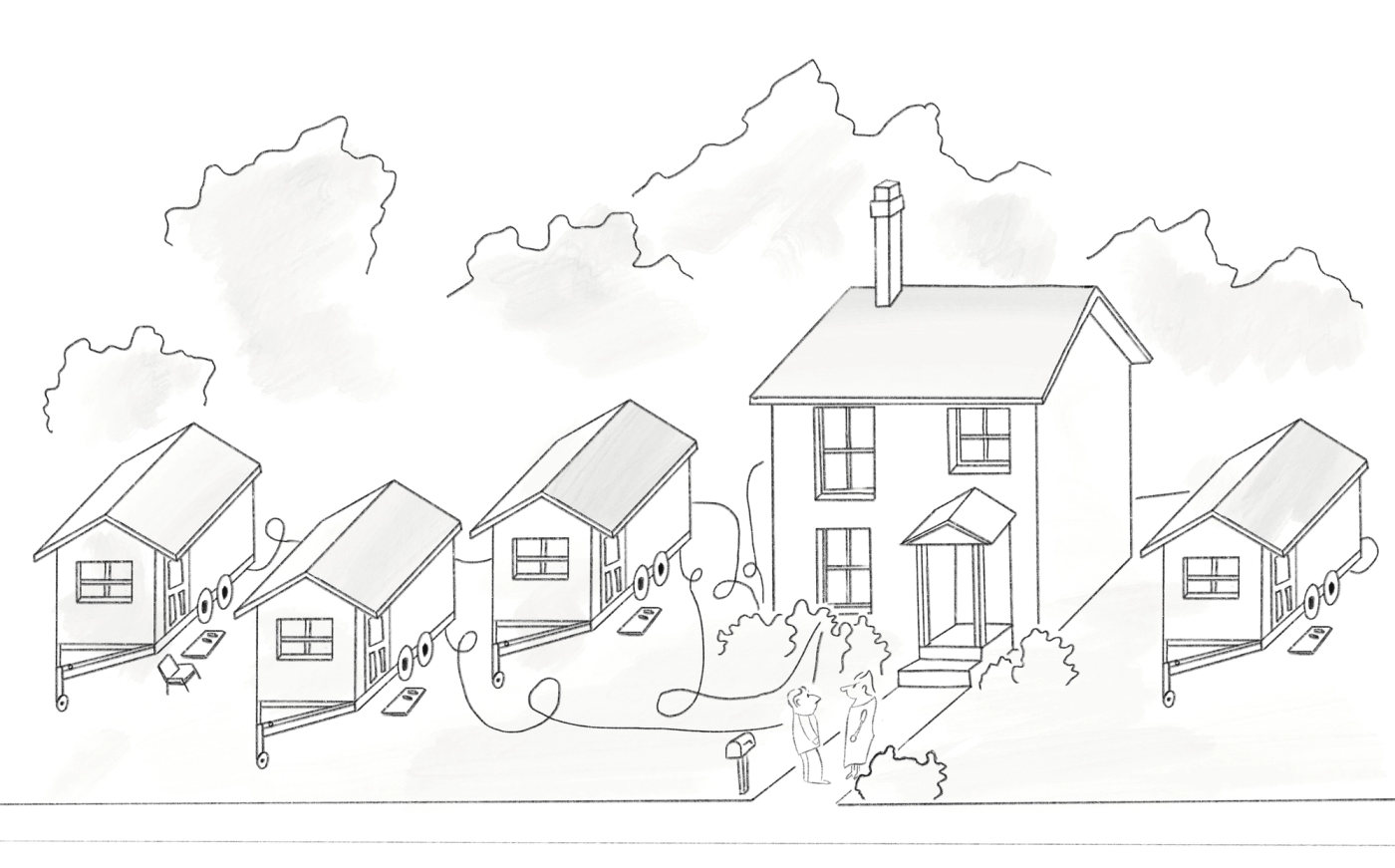
Tiny homes propose separating architecture from land, allowing for a 'flexible' architecture to move with the inhabitant. Promoted on the Tumbleweed Tiny House Company's blog as being able to "hitch up your tiny house" and "relocate with relative ease whenever the mood strikes or life changes", gives a sense of freedom in mobility and financial security to the home purchaser. A building that is flexible to adapt to your future housing requirements. In addition, the rhetoric around tiny homes promotes a subtle protest against private property, liberating the homeowner from these colonial connotations. However, the irony of this is, as April Anson notes, "The assertion that tiny houses challenge private property rights seems to be only applicable to those who already own the property on which the tiny house is parked, or can afford to pay in some other way for the land where the tiny house rests." The ability to move your home seems like a positive of this typology; however, almost ironically, the tiny home is equally reliant on land as a traditional home built on foundations. As noted by Anson, reflecting on her own tiny house experiences, "Parking the tiny house anywhere other than an RV park requires permits that vary widely depending on location and funding". Furthermore, she highlights that parking a tiny home requires "painfully slow" changes to legislation or accepting that parking a tiny home is "borderline criminal living."
This attachment to the land is most evident in the tiny home's connection to building services, such as electricity, water, and waste. As with most buildings, they require inputs (electricity, water, gas, etc.) and outputs (wastewater, sewage, physical trash, etc.). The state provides this to the property and not the building. To be able to connect to these services requires access to land and to the owner's permission to use their resources. Negotiating access to these services can be a challenge for tiny homeowners. Furthermore, as tiny homes are not attached to a property, tiny homeowners are exempt from property tax, even though they may be using the public resources funded by this tax. Therefore, the idea of complete freedom and liberation surrounding the mobility of the tiny home marketed by construction companies is not an accurate representation of the real-life condition.
Originally designed to exploit loopholes by mounting the home on a trailer bed, the freedom of mobility marketed by these tiny homes is only a by-product of their production. By constructing the building on a trailer, tiny home construction companies seek to productise architecture, insulating them from external forces. The most evident external factor is building codes. Without constructing the home on a trailer, the tiny home could not exist as it would be too small to meet building regulations within the United States. Therefore, by putting the home on a trailer, the house falls under recreational vehicle planning laws, allowing for them to be constructed and sold commercially. As the house is not located on a site, no planning policy is required for their construction. Issues with where to site the tiny home becomes the responsibility of the homeowner rather the tiny home construction. They are merely producing a product. Finally, separating architecture from the land through the utilisation of the trailer allows for the extraction of value from building construction without being influenced by the land-property market. This allows for continuous value generation irrespective of current land value or availability. By productising the architecture through the design of the tiny home provides the appearance of stability, allowing them to have greater market appeal.
The design of the tiny home influences the financial models required to purchase a tiny home. As tiny homes do not fall into any existing legal category, occupying a grey area between a trailer, mobile home, recreational vehicle and house, banks do not provide specific financial products that can assist with the costs of purchasing. Therefore, purchasing a tiny home requires significant upfront capital or loans from financial products not designed for tiny home ownership, such as personal loans, which have significantly higher interest rates than conventional home mortgages. For example, Anson required redirecting money from a student loan and relying on financial help from thirty individual members of her friends and family to fund the purchase of her tiny home collectively. Therefore, tiny home ownership requires access to financial capital. This contradicts the rhetoric by tiny house owners of financial liberation. Instead of being in debt to banks, the necessary finances to purchase a tiny home can be a conglomeration of different financial streams (non-mortgage bank loans, family and friend lending, own savings, etc.), shifting financial support (and risk) away from banks and onto the tiny homeowner's social network. Tiny homes are a housing solution for people with financial privilege, not a democratic solution to the housing crisis.
Flexibility in the Plan
Due to the size limitation imposed by the requirement of making this type of tiny home road legal, the internal space of the tiny home has to 'work' harder than a traditional home floor plan. To fit the desired programs of a modern house in such a small internal area, the various building programs must overlap. This is most evident when watching episodes of 'Tiny Home Hunters' where they push the various programs of the building to the extreme. As writer Roxanne Gay writes following watching an episode of the show on HGTV, "I don't want to stand up and hit my head on the ceiling of my house. I don't want the kitchen table to transform into a bed. I don't want a climbing wall on the side of my tiny house." To be an appealing solution, tiny home companies need to be able to offer a comparable level of amenity to a traditional home. Many 'tiny house hunters' seek to have it all with questionable ingenious 'hacks' that would not be permitted under the planning code in traditional domestic construction. It is a conflict between the 'dream' and reality, without questioning either.
This need to overlap programmes makes sense when working with the design of smaller spaces, but tiny homes push this to an extreme in which the home becomes an obstacle. Yet again flexibility is sold as a positive. You can have the kitchen and bath; they just need to adapt. Yet in most cases it is the tiny homeowner that needs to adapt. As this form of home is so compact, there is not enough space to provide separation between spaces. As noted by people who have lived in tiny homes, privacy becomes a big concern, especially for those who do not live alone.
Conclusion
The problems of the tiny home are exacerbated by restrictive planning policy that refuses to embrace alternative forms of housing that could help alleviate housing pressures. Therefore, the tiny house is a product derived from their condition. Tiny home construction companies exploit it to generate value from building construction without land, productising architecture, insulating it from market forces and marketing it disassociated from a context. The form in which these tiny homes take, therefore, is incredibly flexible to the gaps within planning policy. This is most evident in the use of a trailer, which removes the home from domestic building regulation, as the structure falls under the category of a recreational vehicle in the United States. This allows the building to avoid issues with constructing such a house.
Even though Tiny Homes are marketed as a somewhat utopian condition reminiscent of the literary works by Thoreau and Emerson, embracing the ability to move your home and flexibility in how and where you live, many Tiny Homes result from poor planning and financial policy. I do not want to criticise people who live in tiny homes, as this criticism would be misplaced. It results from a condition in which liquid capitalism adapts to gaps within the market to extract value even when the conditions are not optimal. Tiny homes offer a poor solution to a more significant problem, housing affordability. I do believe we should question the types of homes we live in, but I do not think tiny homes are a solution.